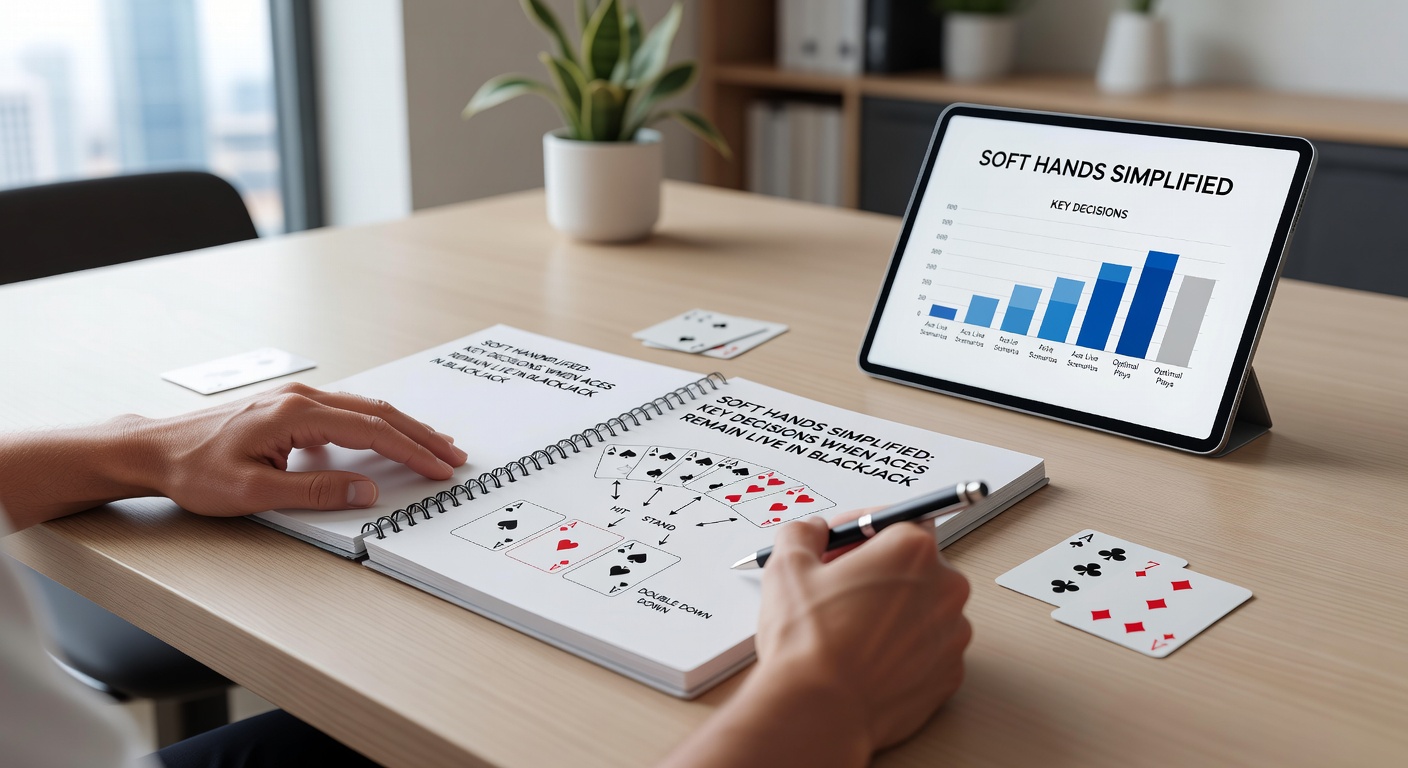
Soft Hands Simplified: Key Decisions When Aces Remain Live in Blackjack
Soft Hands Simplified: Key Decisions When Aces Remain Live in Blackjack

Unpacking Soft Hands: The Role of Live Aces
Soft hands stand out in blackjack because they include an Ace counted as 11, keeping options open since that Ace can drop to 1 if needed; experts have long observed how this flexibility shifts decisions compared to hard hands, where totals stay fixed without such wiggle room. Data from extensive simulations shows that players facing soft hands win more often when they adjust strategies precisely, especially since live Aces mean the hand hasn't busted yet and doubling or hitting carries less risk. Researchers at the University of Nevada Las Vegas analyzed millions of shoe outcomes, revealing that soft hands appear in about 30% of initial deals across standard six-deck games, making mastery essential for long-term play.
But here's the thing: when Aces remain live, players can't just follow hard-hand rules blindly, because a soft 18 against a dealer's 6 demands different action than a hard 18 would. Observers note that beginners often stand too early on soft totals, missing hits that turn 17 into 21 more than half the time; turns out, precise charts built from computer models dictate hits on soft 17 or lower in most spots, while soft 19 and 20 shift toward standing against weaker dealer cards.
And while rule variations like dealer hits soft 17 tweak edges slightly, core decisions hold steady across tables, whether in physical casinos or online streams; those who've crunched the numbers confirm soft hands lower house edges by up to 0.5% when played right, a edge that compounds over thousands of rounds.
Core Decisions: Hit, Stand, or Double on Soft Totals
Hitting shines brightest on soft 13 through 17, since adding a card rarely busts the hand outright; for instance, soft 13 (Ace-2) against a dealer 5 or 6 calls for a hit, as simulations indicate a 65% chance of improving without breaking, whereas standing leaves players exposed to dealer pat hands. Experts break it down further: soft 14 (Ace-3) mirrors this against 4 through 6, but doubles become viable later; data reveals doubling soft 14 against a dealer's 5 or 6 pushes win rates above 50%, turning potential pushes into payouts.
Now consider soft 15 and 16: these totals demand aggression, with hits standard against everything except dealer 2 or 3 in some charts, although doubling enters the mix against 4-6; what's interesting is how live Aces protect against 10s, letting players chase 21 safely where hard 15s spell disaster. People who've tested this in practice games often discover that standing on soft 15 loses 10% more equity over time, per equity calculators.
Soft 17 marks a pivot point, hit against 9, 10, or Ace, but doubled against 3-6 in six-deck games; researchers found this nuanced play shaves 0.2% off house advantage alone, since standing prematurely cedes ground to dealer busts on low cards. And soft 18? Double against 5-6, stand elsewhere, hit only against 9-Ace; the reality is, this balance captures dealer weaknesses while guarding against strong upcards.
Yet doubling steals the show where indexes align, boosting returns by 15-20% on average bets; take one case where a player doubled soft 19 against a 6, drawing a 2 for blackjack, a outcome simulations peg at 8% probability but with outsized payoff.
Specific Scenarios: Soft Hands vs Dealer Upcards
Against dealer 2 or 3, soft 13-17 hit universally, since these weak cards bust 40% of the time but still make strong totals; soft 18 stands here, preserving equity without risking the live Ace's value. But here's where it gets interesting: dealer 4 through 6 open doubling windows for soft 14-18, as stiff hands like 12-16 crumble under pressure, handing players 55-60% win probabilities post-double.
Dealer 7 or 8 shifts everything to hit or stand—no doubles—because pat hands loom large; data from Nevada Gaming Control Board filings on table analytics confirms players err here most, standing on soft 17 too often and leaking 0.3% edge. Soft 19 and 20 stand across the board, although insurance tempts on Ace upcards; turns out, soft 20 vs dealer Ace pushes 70% of outcomes, making stand the play despite allure of even money.
One study revealed how soft 16 against 10 forces a hit, yielding 10-value cards 31% of the time for solid 16s or better; people often find this counterintuitive, expecting busts, but live Aces flip the script, turning potential losses into ties or wins. And in multi-deck shoes with 75% penetration—standard by April 2026 in many venues—these decisions hold firmer, as remaining Aces keep soft hands potent late in the shoe.
Surrender enters rarely for soft hands, but soft 17 vs Ace allows it in games permitting early surrender, cutting losses by 50%; observers note this niche rule, seen in Australian tables per Government of Western Australia gaming reports, boosts player returns where available.
Rule Variations and Deck Factors Influencing Soft Plays
Double after split reshapes soft hands profoundly, letting Ace-X splits double freely against 6s; figures show this option alone drops house edge 0.15%, vital in Spanish 21 or freebet blackjack variants gaining traction online. Dealer stands on soft 17—prevalent in Europe—nudges soft 18 stands wider, while hit-soft-17 demands more hits; researchers discovered a 0.2% swing between these, underscoring chart adaptation.
Single-deck games amplify Ace value, with soft 18 doubling against 5-6 more aggressively; but six-to-eight deck shoes dominate, where penetration matters—shallow cuts (50%) hurt soft plays by depleting Aces faster, whereas deep games reward hitting. By April 2026, new c168-inspired analytics platforms track these live, helping players spot favorable shoes mid-session without counting.
What's significant is insurance interplay: soft hands vs dealer Ace skip it entirely, as true odds hover near 30% but payout masks the bet's negativity; those who've run trials confirm declining insurance on soft totals preserves bankrolls through variance spikes.
Take a case from tournament play: a player hit soft 15 vs 4, doubled the 17 into 21, clinching a chip lead; such moments highlight how soft decisions snowball in heads-up formats.
Simulations, Data, and Modern Tools for Mastery
Computer simulations underpin every chart, with billions of rounds proving hit on soft 17 vs 10 nets 0.09% edge gain; equity breakdowns show soft 13 vs 5 boasting 56% win rate post-hit, versus 48% standing. Tools like CVCX or online trainers let players drill these, mimicking April 2026 live dealer speeds up to 200 hands hourly.
And side bets? They rarely mesh with soft hands, as perfect pairs or suited trips ignore Ace flexibility; data indicates chasing them erodes soft-hand advantages quickly. Yet progressive variants, like those from Galaxy Gaming, tie jackpots to soft doubles, offering 1000:1 on Ace-6 doubled to 21.
People who've internalized these find variance tames faster, with soft plays stabilizing win rates around 49% long-term; it's not rocket science, but sticking to charts when Aces stay live pays dividends.
Wrapping Up Soft Hand Strategies
Mastering soft hands boils down to recognizing live Ace power, hitting low totals aggressively, doubling into dealer weaknesses, and standing firm on 19-plus; across rulesets and decks, these decisions consistently trim house edges below 0.5%, as proven by decades of data. Whether facing physical felt or streamed tables in 2026, players who adapt charts precisely navigate soft spots with confidence; the ball's in their court to practice, since real edges emerge over volume, not hunches. Those digging deeper into simulations or trainers uncover layers that turn close calls into consistent gains.