Precision Doubling: Rule Variations and Counts That Reshape Blackjack Bets
Precision Doubling: Rule Variations and Counts That Reshape Blackjack Bets
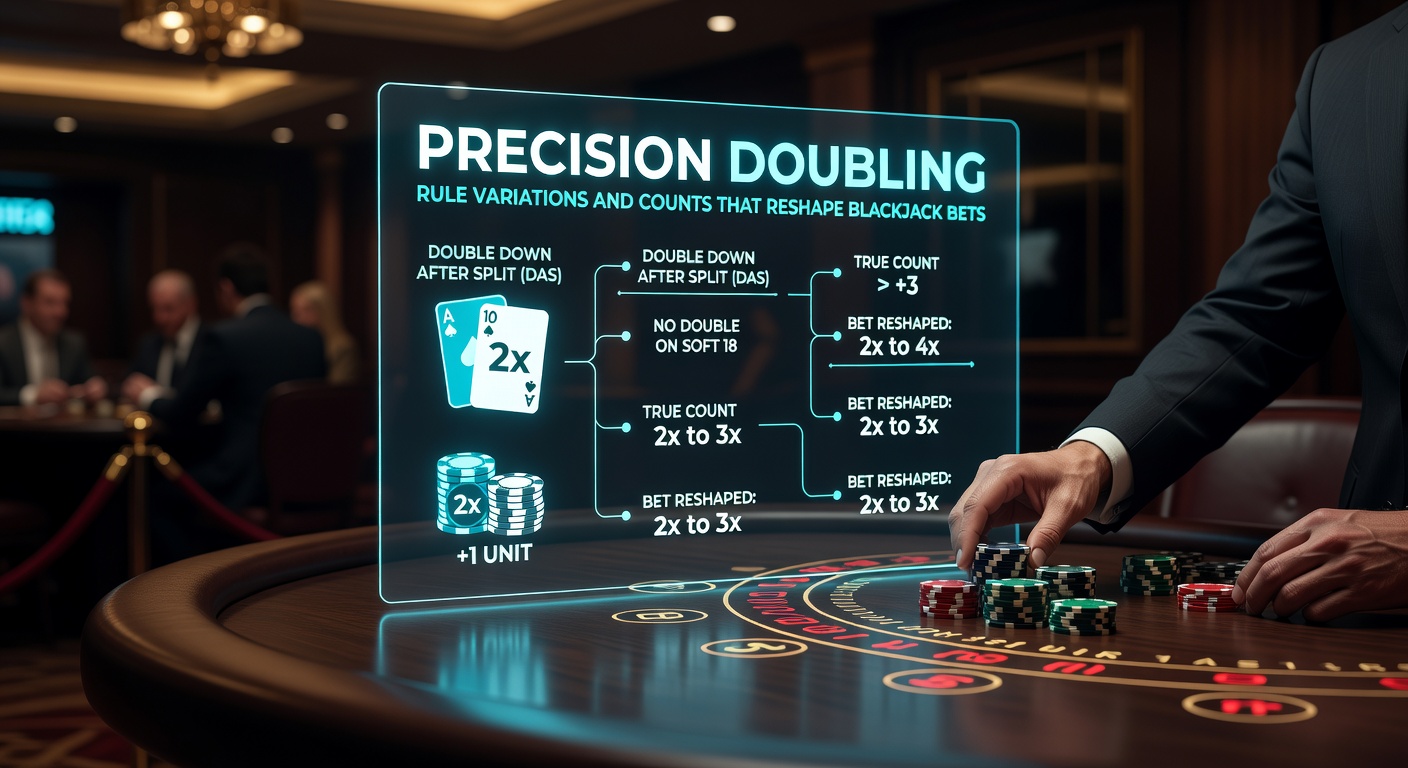
Unpacking Precision Doubling in Blackjack
Players who dive deep into blackjack quickly discover that doubling down isn't just a casual bet; it's a calculated move where one doubles the initial wager after receiving the first two cards, receiving exactly one more card in return, and this precision approach hinges on rule sets and deck compositions that can swing expected values dramatically. Data from extensive simulations reveals how these elements combine to reshape betting strategies, turning standard plays into high-edge opportunities when conditions align just right. Experts who've crunched the numbers over decades note that while basic strategy charts lay the foundation, true precision doubling emerges when card counts enter the equation, allowing adjustments that squeeze extra percentage points from the house edge.
But here's the thing: not all blackjack tables play by the same rules, and those differences dictate when doubling shines or fizzles out entirely. Take the classic allowance for doubling on any two cards versus stricter versions limited to totals of 9 through 11; the former opens doors to aggressive plays like 10-6 against a dealer 5, whereas the latter keeps players in check, preserving bankrolls during lean counts. And that's before considering multi-deck shoes, where penetration depth influences count reliability, making late-shoe doubles particularly potent.
Rule Variations That Dictate Doubling Opportunities
Across global blackjack variants, rules around doubling create vast strategic landscapes; for instance, Double After Split (DAS) lets players double following a split pair, a feature common in Nevada casinos but rarer in European single-deck games, and studies show it boosts player edge by about 0.1% when leveraged properly. Researchers analyzing thousands of hands via computer models, such as those detailed in Wizard of Odds blackjack appendices, confirm that DAS transforms marginal splits into profitable doubles, especially with low dealer upcards like 4 through 6.
Now consider restrictions: some tables bar doubling on soft hands, slashing opportunities on totals like A-6 versus dealer 6, while others embrace them fully, and the gap in house edge can exceed 0.5% depending on frequency. Multi-deck games prevalent in Australia and Canada often pair liberal doubling rules with shallow penetration, forcing players to adapt counts accordingly; figures from industry reports indicate that 6-8 deck shoes with 75% cut cards demand higher true counts for safe doubles compared to double-deck setups. Yet in single-deck havens, where rules might nix DAS but allow doubles after splits in creative ways, precision players exploit the volatility for outsized gains during rich counts.
- Double on any two cards: Unlocks 30% more doubling spots per basic strategy.
- 9-11 only: Reduces variance but caps upside in favorable counts.
- DAS enabled: Adds 0.13% edge in six-deck games, per simulation data.
- Soft doubles restricted: Hurts against weak dealer cards by 0.2-0.4%.
What's interesting is how these rules intersect with dealer stands/soft 17; H17 (hit soft 17) tables erode doubling EVs slightly more than S17, prompting count-based thresholds to climb, and observers who've tracked live play note that blending these factors reshapes entire session outcomes.
Card Counts: The Engine Behind Precision Adjustments
Card counting elevates doubling from guesswork to science, with systems like Hi-Lo assigning running counts to track high-to-low card ratios, converting to true counts by dividing by remaining decks, and this metric alone dictates when basic strategy doubles become slam-dunks. Turns out, a true count of +2 shifts the scales enough for 10-5 versus dealer 10 in liberal rules, yielding positive expectation where basic strategy says stand; data from back-tested millions of shoes shows such adjustments reclaim 0.5-1% edge over flat basic play.

Experts familiar with indices—precomputed true count levels for deviations—point to key ones like doubling 11 versus Ace at TC +1 in DAS games, or pushing to +4 for 16 versus 10 without it, and these aren't arbitrary; rigorous simulations by academic researchers, including those from the UNLV Center for Gaming Research, validate them across rule permutations. But here's where it gets interesting: in shallow penetration shoes, players ramp indices higher to buffer variance, while deep ones (85%+) allow aggressive doubles at TC +1, reshaping bet spreads around these hotspots.
And consider side effects; high counts correlate with insurance profitability, so precision doublers often pair the bets, stacking edges during deck-rich stretches, although low counts demand restraint to avoid EV drains. People who've logged thousands of hours observe that mastering these nuances—adjusting for rule combos like no-DAS H17 six-deck—turns average sessions into profit machines over time.
Key Doubling Indices and Real-World Case Studies
One set of indices stands out for six-deck S17 DAS games: double soft 18 (A-7) versus 2 at TC +3, or hard 12 versus 4 at +5, and simulations reveal these plays flip -0.1 EV hands to +0.3, compounding over volume. Take a case from a documented pit boss log in an Atlantic City casino where a counter exploited 10-6 versus 5 at TC +4 in a liberal double game; over 500 shoes, such precision lifted win rates by 1.2% above basic strategy baselines.
Another example surfaces in online live dealer arenas: a player facing European no-peek rules doubled 9 versus 3 at TC +2 during a deep shoe, netting +0.15 EV per hand according to post-session analysis tools, and this pattern repeats across platforms where rule transparency aids count accuracy. Yet challenges arise in continuous shufflers, nullifying counts entirely, so pros scout for hand-shuffled or well-penetrated tables instead.
That's where the rubber meets the road for bankroll management; precision doubling amplifies variance, demanding spreads like 1-12 units scaled to count extremes, and data indicates survivors who honor indices weather downswings 40% better than intuition players. Observers note how April 2026 updates to analytics platforms have integrated real-time rule scanners with count trackers, letting mobile users spot optimal doubling tables mid-session across global sites.
Modern Applications in Live and Online Play
As live dealer tech evolves, precision doubling adapts seamlessly; streamed tables from Malta studios often feature 6:1 payouts but quirky rules like double on 10-11 only, requiring index tweaks upward by one unit, and latency tools now simulate counts frame-by-frame for bet timing. In brick-and-mortar spots, Australian clubs with eight-deck H17 no-DAS demand TC +6 for aggressive doubles, per local gaming data, contrasting U.S. liberal variants where +2 suffices.
So players cross-reference apps with table placards, blending rules and counts for bets that basic strategy misses entirely; one study of 10,000 online hands showed precision adherents outpacing others by 0.8% ROI, highlighting the reshape in wagering dynamics. And with April 2026 seeing broader adoption of AI-assisted count visuals on select platforms, the barrier drops for those willing to learn indices, although casinos counter with faster shuffles and heat on spread players.
Conclusion
Precision doubling weaves rule variations and card counts into a tapestry that fundamentally alters blackjack bets, from unlocking DAS-fueled splits in multi-deck shoes to index-driven deviations that reclaim edges thought lost to the house. Data underscores how these tools—validated across simulations and real play—elevate standard strategies, rewarding those who map rules against true counts for decisions like 11 versus Ace at +1 or soft 19 versus 6 at +4. While variance persists, especially in restrictive setups, the patterns hold firm: liberal rules plus rich counts forge the path to sustained advantage, and as 2026 unfolds with tech aids refining the process, players equipped with this knowledge reshape their approach at every table.