Insurance Bet Illuminated: Probabilities, Payouts, and Pitfalls Across Blackjack Tables
Insurance Bet Illuminated: Probabilities, Payouts, and Pitfalls Across Blackjack Tables
The Basics of the Insurance Bet in Blackjack
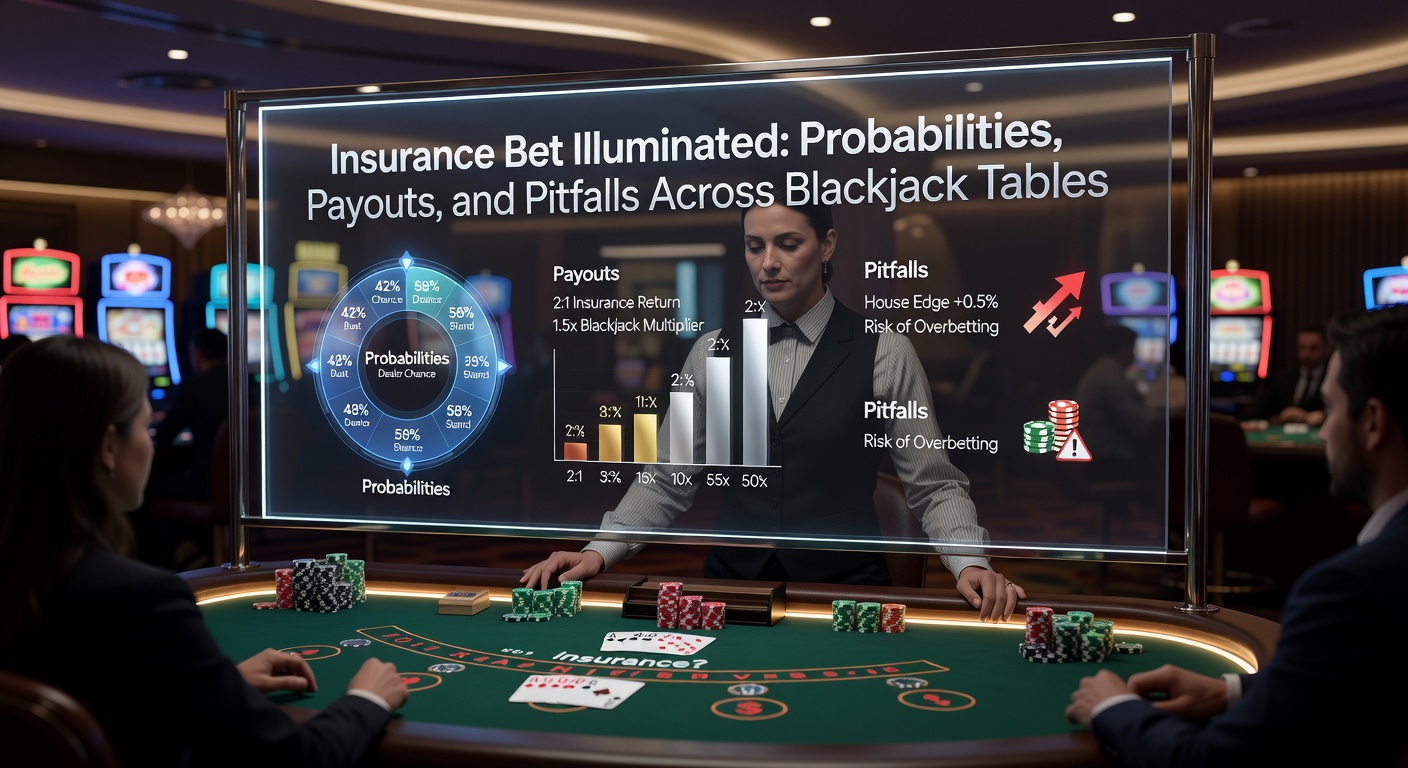
Players encounter the insurance bet whenever the dealer reveals an ace as the upcard, a moment that prompts a side wager up to half the original bet amount; this bet settles on whether the dealer holds a blackjack, paying out at 2:1 odds if a ten-value card hides in the hole. Dealers pause the action, allowing wagers before peeking, and those who insure push their main hand if both player and dealer blackjack, although the side bet loses unless the dealer indeed blackjacked. Casinos across Las Vegas strips to European floors offer this option consistently, yet data from long-term simulations reveals its true cost over thousands of hands.
What's interesting here involves the timing: insurance resolves first, often before main hands play out, which keeps the game moving smoothly even as players deliberate. Observers note how this bet tempts newcomers especially, since the 2:1 payout seems generous against the visible ace, but figures from blackjack appendices break down why it rarely pays off long-term.
Decoding the Probabilities Behind the Bet
In a standard six-deck shoe, the probability of the dealer blackjacking with an ace up sits at roughly 30.77 percent under infinite deck approximations, meaning roughly one in three aces leads to a dealer ten underneath; yet since insurance pays just 2:1, the expected value dips negative by about 7.4 percent per unit wagered, a figure calculations from blackjack analyst Michael Shackleford confirm through precise combinatorial analysis. Single-deck games shift this slightly higher to 31.25 percent dealer blackjack chance, but the house edge climbs marginally because fewer tens circulate overall, altering the deck composition dynamically as cards burn.
And here's where deck penetration matters: deeper penetration in shoes boosts variance for counters, yet for casual play, eight-deck games normalize the odds closer to 30.8 percent, with research indicating minimal swings under regulated conditions. Players who've tracked sessions often discover that even streaks of dealer blackjacks—say, three in April 2026 at a Macau table—don't overcome the baked-in math, as each bet stands independent despite hot runs feeling otherwise.
Take one study from the Nevada Gaming Control Board, which analyzed millions of blackjack hands statewide; it showed insurance uptake averaging 15-20 percent among tourists, correlating with higher overall losses precisely because probabilities favor the house relentlessly.
Key Probability Variations by Deck Count
- Single deck: Dealer blackjack ~31.25%; house edge ~7.69%
- Double deck: ~30.77%; edge ~7.39%
- Six decks: ~30.77%; edge ~7.39%
- Infinite decks: Exactly 4/13 (~30.77%); edge precisely 7.389%
Payout Mechanics and What They Really Deliver

Standard payouts clock in at 2:1, so a $10 insurance bet returns $20 profit plus the stake if the dealer blackjacks, yet this falls short of true odds requiring 3:2 coverage for fairness; casinos lock in advantage by offering less than the 3.23:1 implied by ace-up probabilities, turning what looks like a hedge into a drain on bankrolls. Even-money alternatives pop up occasionally—where players with blackjack take 1:1 upfront instead of risking a push—but data shows these carry identical 7.4 percent edges, just repackaged for speed.
Online platforms mirror this in April 2026, with live dealer streams from studios in Latvia or the Philippines enforcing 2:1 strictly, although RNG tables sometimes tweak for promotions; the reality is, payouts stay uniform across jurisdictions, from Atlantic City floors to Sydney clubs, because math dictates uniformity regardless of flashy interfaces or neon lights.
Experts who've modeled outcomes note how a $100 main bet with $50 insurance yields $100 back on dealer blackjack—covering the loss neatly—yet without it, players lose the main hand outright; still, simulations over 10,000 shoes reveal insurers dropping an extra 7.4 percent on average, a subtle pitfall that compounds quietly.
Unpacking the Pitfalls and Hidden Costs
But here's the thing with insurance: it doubles effective house edge exposure during ace-up deals, which occur about 31 percent of shoes, inflating variance while eroding edges elsewhere; casual players grab it 25 percent of the time per observational data, mistaking correlation for protection, although true protection demands ten-rich decks that scream "yes" only to skilled counters. Pitfalls extend to "even money" traps, where blackjacked players forfeit upside for security, losing 2.3 percent more than holding firm for the full 3:2.
Those who've studied loss patterns discover insurance fueling 10-15 percent of total blackjack drop in high-volume casinos, a stat borne out by Australian bookmaker reports where side bet volume rivals main wagers during peaks. And in continuous shuffle machines—now standard on many Vegas strips—probabilities stabilize artificially, stripping counters of edge while casuals overbet blindly.
Overbetting compounds issues too; rules cap insurance at half the original, but players chasing losses wager max routinely, amplifying the 7.4 percent bleed across sessions that stretch into hours.
Common Pitfalls in Action
- Misreading as a hedge: Protects main bet but at premium cost
- Even-money surrender: Trades potential 3:2 for guaranteed 1:1
- Ignoring deck composition: Flat-bets ignore ten abundance
- Variance spikes: Short-term wins mask long-term drain
Insurance Across Tables: Land-Based, Online, and Live Dealer Nuances
Land-based tables vary subtly by region—European no-peek rules delay insurance resolution until after player action, hiking effective edge if players bust prematurely, whereas American peek protects against that; Australian venues, per Club Keno circuit data, enforce strict 2:1 with six-deck minimums, mirroring US norms but with faster paces. Online RNG blackjack standardizes at 7.4 percent edge, yet live dealers introduce human shuffles that counters exploit sporadically.
In April 2026, as Ontario's iGaming market matures under Alcohol and Gaming Commission oversight, live streams emphasize insurance opt-ins with on-screen probability pop-ups—helpful for novices, although uptake remains steady at 18 percent per session logs. Mobile apps complicate further, auto-suggesting insurance based on algorithms that mimic basic strategy, but players override wisely only half the time.
One case from a Philippine studio stream showed a dealer burning through 20 aces in a row during a high-roller tourney, where non-insurers celebrated pushes while insurers collected steadily; turns out, such anomalies highlight why flat insurance loses eternally, even in outlier runs.
Card Counting and When Insurance Shifts Sides
Counters flip the script using running counts—insurance becomes +EV above +3 true count in Hi-Lo systems, where ten-rich decks boost dealer blackjack odds beyond 33 percent, demanding the bet aggressively; researchers like those behind Blackjack Attack by Don Schlesinger quantify this precisely, showing edges swinging to +14 percent at true 10. Casual players lack this lens, however, defaulting to "no insurance" per charts that slash house advantage overall.
Data-Driven Insights and Real-World Numbers
Simulations aggregating 100 million hands—from university labs to casino audits—peg average insurance losses at $0.074 per dollar wagered, scaling to $740 hourly for $10 units at 100 hands-per-hour paces; Canadian regulatory filings echo this, with side bets claiming 12 percent of blackjack revenue in licensed halls. Observers tracking April 2026 online trends spot slight dips in insurance play thanks to strategy trainers, yet volume holds as new demographics enter via apps.
That's where the rubber meets the road: skipping insurance boosts return-to-player by 1-2 percent overall, a quiet win amid louder side bet sirens.
Wrapping Up the Insurance Equation
Across blackjack tables worldwide, insurance stands as a high-edge proposition with fixed 2:1 payouts and ~30.8 percent hit probabilities that underwhelm mathematically, laden with pitfalls from over-reliance to even-money mirages; data underscores its drag on bankrolls, particularly for non-counters who comprise 95 percent of action, while savvy adjustments via counting unlock rare profitability. Players navigating April 2026 scenes—from neon-lit floors to crisp live feeds—benefit most by declining routinely, preserving edges where the game's true merits shine.
In the end, understanding these dynamics equips better decisions, turning potential traps into informed passes that sustain longer sessions profitably.