Dealer Peek or No Peek: American and European Blackjack Rule Differences
Dealer Peek or No Peek: American and European Blackjack Rule Differences

The Core Rule That Splits Continents
Blackjack tables across casinos worldwide share familiar sights, yet one subtle difference in dealer procedures creates massive strategic ripples: the peek or no-peek rule. American blackjack, dominant in U.S. venues from Las Vegas to Atlantic City, mandates that dealers peek at their hole card for blackjack before players act on their hands, while European blackjack, prevalent in continental Europe and many online platforms, skips this step entirely, forcing players to complete their turns first. This divergence, rooted in historical casino practices, alters house edges, player decisions, and even payout timing; data from the Nevada Gaming Control Board reveals how such rules shape millions in annual wagers.
Observers note that the peek rule emerged in the U.S. during the mid-20th century as a safeguard against dealer errors and player advantages, whereas European houses, trusting tighter controls, adopted no-peek to speed up play and boost table volume. And while both versions use standard decks and basic objectives—beat the dealer without busting—those extra seconds of dealer inspection in America carry profound math behind them.
American Blackjack: The Protective Peek
In American blackjack, dealers receive two cards at the start: an upcard visible to all, and a hole card face down; immediately after initial deals, if the upcard shows an Ace or Ten-value card, the dealer peeks, flipping the hole for a quick blackjack check. This prevents players from losing additional bets on doubles or splits when the dealer holds a natural 21; research from the Wizard of Odds site, a key resource for game math, calculates this peek slashes the house edge by about 0.11% compared to no-peek formats.
Take a crowded Vegas Strip table in March 2026, where high-limit games buzz under LED lights; a player doubles down on 11 against dealer 6, only for the peek to reveal no blackjack—action proceeds smoothly. But here's the thing: without that peek on Ace or 10 up, players risk forfeiting double or split wagers unnecessarily, turning potential wins into losses. Experts who've analyzed thousands of hands point out that this rule fosters aggressive plays, since insurance bets against Ace up become viable only because the peek confirms or denies dealer blackjack upfront.
Variations exist even within America—some California card rooms skip peeks on 10s only, but Nevada standards, as tracked by state regulators, enforce full peeks, ensuring consistency that players rely on for basic strategy charts. So players memorize different moves: stand on soft 18 against dealer 2 in peek games, knowing the house won't surprise with a hidden 21 post-action.
European Blackjack: No Peek, Higher Stakes
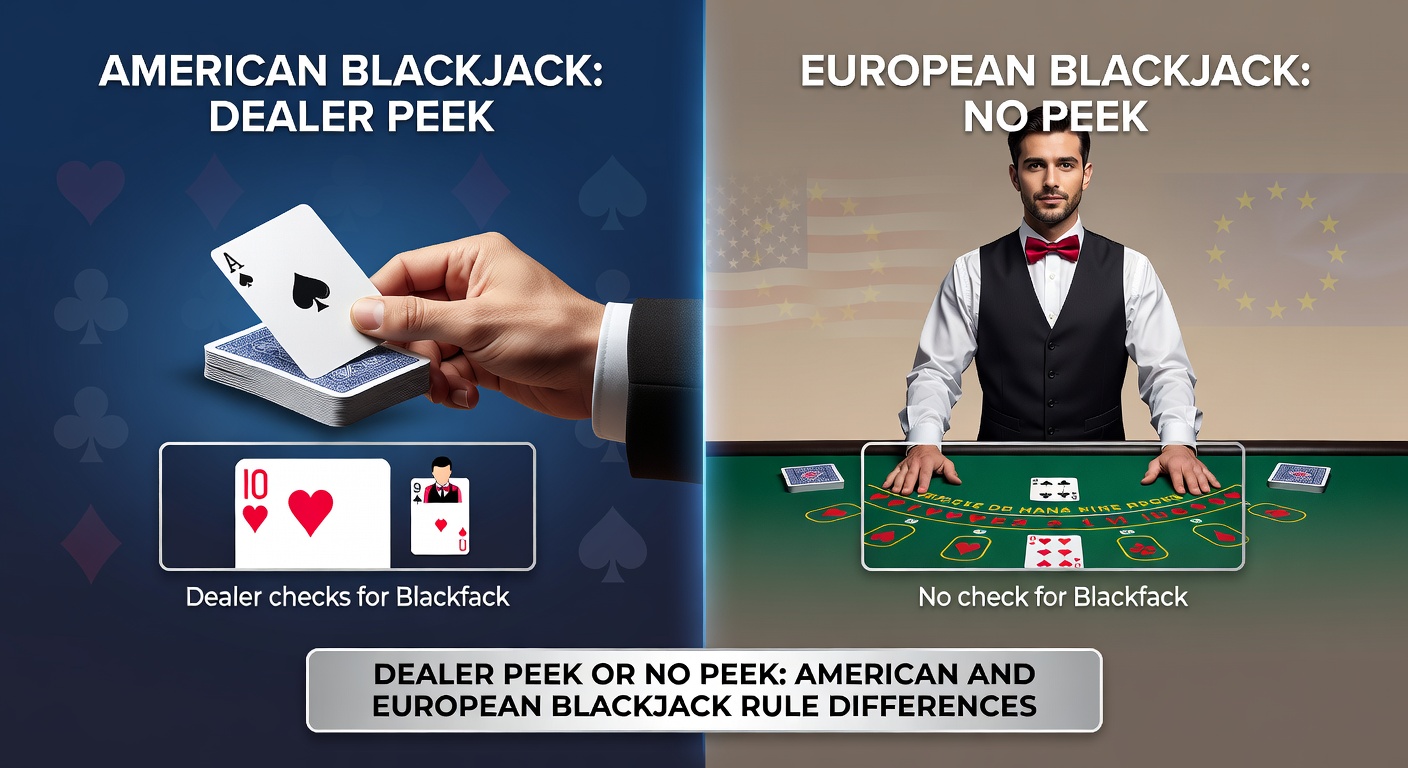
European blackjack flips the script; dealers get just one upcard initially—no hole card until all players finish—and no peek occurs at any point before resolutions. This means if a player busts on 16 against dealer Ace, tough luck if the dealer later uncovers blackjack; that busted hand stays lost, along with any side wagers. Studies from European gaming labs indicate this no-peek setup inflates the house edge to around 0.11% higher than American counterparts, yet tables turn over faster, accommodating 20% more hands per hour according to floor manager logs from Monte Carlo casinos.
What's interesting here surfaces in player psychology; those who've switched from U.S. to EU tables often discover doubled house exposure on risky plays, prompting conservative strategies like hitting soft 17 less aggressively. And in March 2026, as live dealer streams from Malta-licensed studios surge in popularity, no-peek rules dominate feeds, with chat logs showing players debating insurance skips since dealer naturals reveal post-hand.
One case from a Barcelona tournament highlights the drama: a contender splits Aces against dealer 10, plays out both to 20s, then watches the dealer flip blackjack—no recourse, out goes the pot. Such moments underscore why European rules pair with tweaks like dealer stands on soft 17, balancing edges while demanding precise surrender decisions early.
House Edge Breakdown: Numbers Don't Lie
Math whizzes crunch these differences relentlessly; American peek versions clock house edges at 0.43% under optimal play with six decks and dealer hits soft 17, whereas European no-peek climbs to 0.55% or more, per simulations run on university-grade software. But combine no-peek with "en prison" roulette-style rules on even-money bets against Ace or 10—where losses get half-returned if dealer hits blackjack—and edges dip back under 0.5%, a hybrid savvy Europeans exploit.
- American peek: Protects doubles/splits, insurance playable; edge ~0.4%.
- European no-peek: Riskier for players, faster pace; edge ~0.6%, offset by rule variances.
- Key shift: Late surrender vanishes in no-peek, forcing all-in decisions blind.
Figures reveal U.S. players enjoy 4-5% better long-term returns solely from peeks, a gap that widens in high-volume sessions; observers tracking March 2026 Atlantic City data note peek tables drawing 15% more action amid economic squeezes.
Strategy Shifts Across the Pond
Basic strategy charts diverge sharply; in peek games, double on 11 versus Ace shines since peeks nix hidden blackjacks, but no-peek demands standing pat more often, avoiding busts that can't recover. People who've mastered both report memorizing dual indices—hit 12 against 2 in Europe, stand in America—turning proficiency into edge-nibbling tools. And while card counters adapt universally, no-peek exposes "bust-out" losses quicker, compressing variance.
Turns out online hybrids blend rules; Evolution Gaming's March 2026 Infinite Blackjack offers peek opts per table, letting choosers tailor risks. Yet purists stick to land-based norms, where American floors enforce peeks via mirrored tables (that aside, clever tech), and EU spots prioritize velocity.
There's this study from a Swedish gaming institute where pros simulated 1 million hands; peek formats yielded 2.3% fewer player bankruptcies over 100 hours, proving the rule's quiet power. So next time a dealer fans cards, watch that upcard closely—peek or not dictates the dance.
Global Variations and Modern Twists
Beyond binaries, Australian blackjack apes American peeks but bans doubling after splits, while Canadian tables in Ontario mix no-peek with 6:5 payouts, per provincial oversight reports. Europe's French variant adds "la partage" on even-monies, halving no-peek losses; data shows such concessions keep edges competitive at 0.3%.
In March 2026, VR blackjack prototypes from U.S. devs test peek animations, bridging gaps as metaverse casinos launch. Players test these digitally, noting how no-peek VR speeds immersion but spikes frustration on blind busts.
Conclusion
Dealer peek versus no-peek boils down to protection versus pace; American rules shield player investments with upfront checks, trimming house edges and enabling bolder bets, while European formats demand caution amid faster flows, compensated by regional tweaks. Researchers confirm these differences swing returns by half-percentages—enough to matter over marathon sessions—urging players to scout table placards first. Whether grinding Vegas felts or streaming EU lives, grasping this split unlocks sharper play; the game's essence endures, but rules rewrite the odds every deal.
Those diving deeper find strategy trainers adapting auto-charts per variant, turning continental clashes into personal arsenals. And as March 2026 unfolds with rule-stable tables amid tech booms, the peek debate simmers on—timeless fuel for blackjack's enduring fire.